


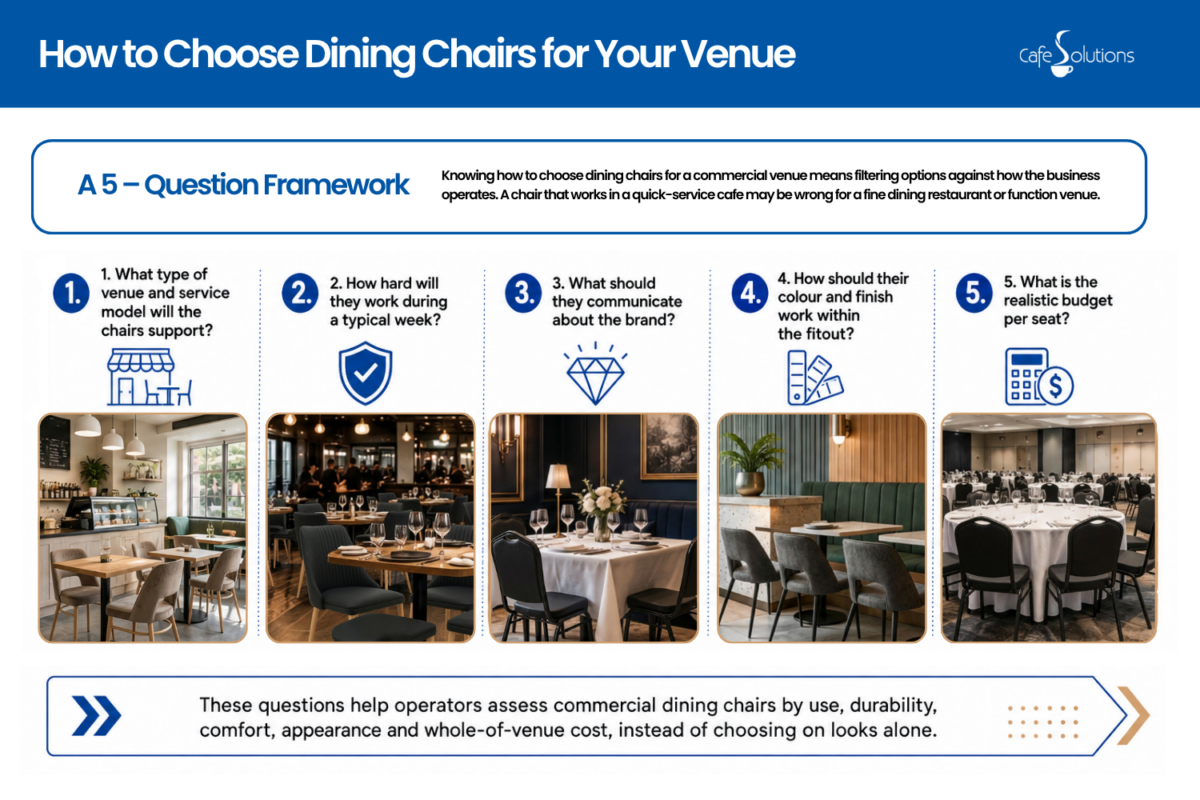
Knowing how to choose dining chairs for a commercial venue means filtering options against how the business operates. A chair that works in a quick-service cafe may be wrong for a fine dining restaurant or function venue.
Before comparing models, ask five questions:
- What type of venue and service model will the chairs support?
- How hard will they work during a typical week?
- What should they communicate about the brand?
- How should their colour and finish work within the fitout?
- What is the realistic budget per seat?
These questions help operators assess commercial dining chairs by use, durability, comfort, appearance and whole-of-venue cost, instead of choosing on looks alone.
Key Takeaways
- Start with the venue type and service model, then narrow the range by material, dimensions, comfort and cost.
- Standard dining chairs generally need a seat height of 45 to 47 cm to work with a table around 75 cm high.
- High-turnover venues usually benefit from light, hard-wearing and easy-to-clean chairs. Longer dining formats can justify upholstery, armrests and deeper seats.
- Stackability matters when chairs are moved daily, floor space serves several purposes or the venue hosts functions.
- Set a budget per usable seat, including delivery, assembly, cleaning and likely replacement, rather than comparing unit prices alone.
Question 1: What Type of Venue and Service Model Will the Chairs Support?
The first filter is not a design style. It is the way the venue serves customers. Table turnover, average visit length, menu format and room layout all change what a suitable chair looks like.
Cafes and quick-service venues
Busy cafes generally need chairs that are compact, light and simple to wipe down between customers. Polypropylene, powder-coated steel and other non-porous surfaces suit frequent cleaning. A relatively upright seat can support shorter visits without making the chair feel unwelcoming.
Lightweight, stackablecafe chairs also reduce the effort involved in joining tables, accommodating prams and resetting the floor.
Bistros and casual restaurants
A bistro or casual restaurant needs more comfort than a quick-service cafe while maintaining steady turnover. Bentwood chairs provide shaped backs and recognisable curves without the bulk of lounge-style seating.
Thebentwood dining chair range works well with timber or stone-look tables and suits traditional European, neighbourhood and contemporary bistro identities.
Fine dining venues
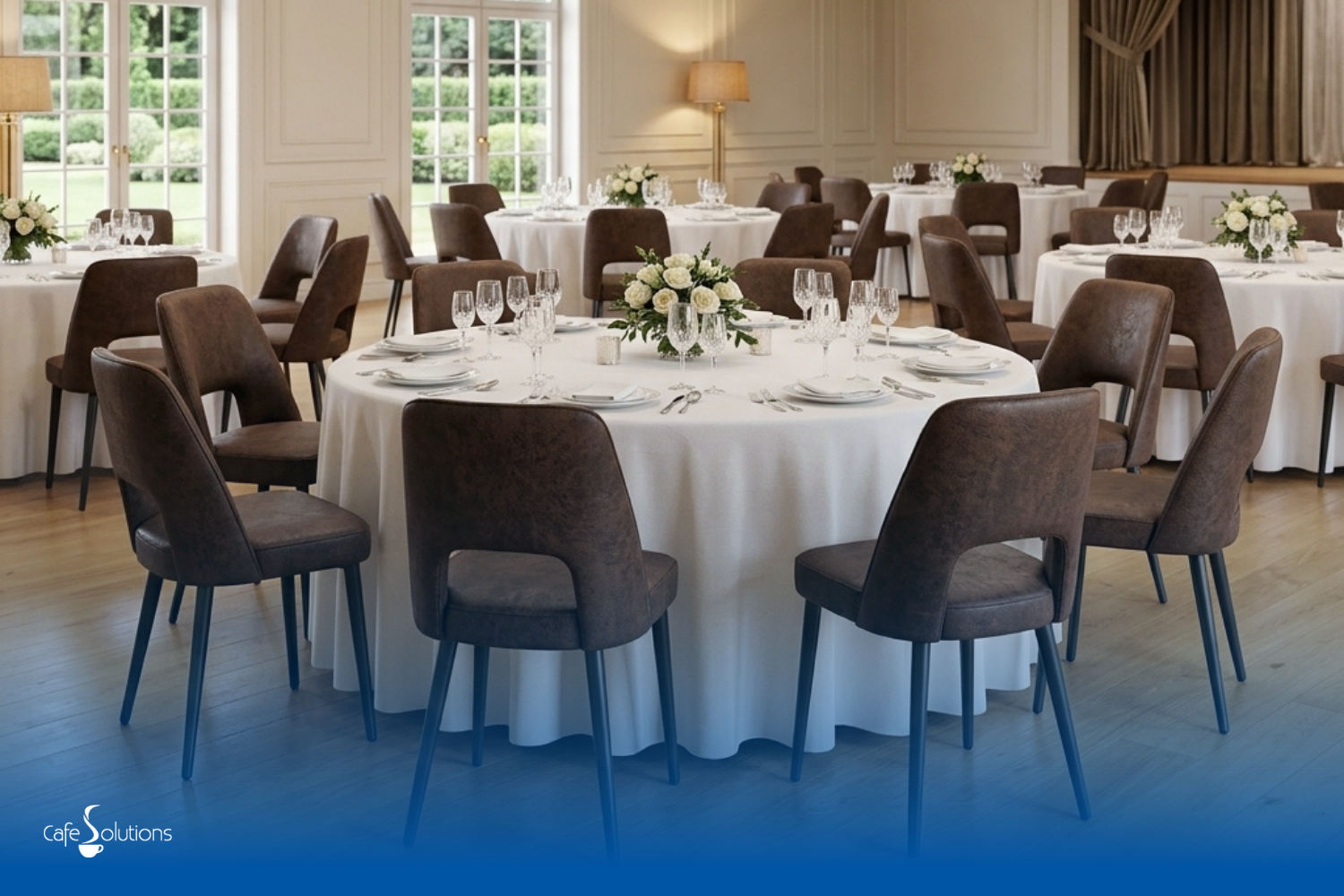
Fine dining guests may remain seated through several courses, so support and seat depth deserve greater weight.Upholstered dining chairs provide a softer seat and substantial appearance. PU leather simplifies wiping, while fabric adds texture but requires a stain-management plan.
Anarm chair can work at selected tables or in waiting areas. Armrests need more lateral space and must clear the table apron, so measure before specifying them throughout the room.
Function and multi-use venues
Function rooms need chairs that staff can move, stack and store efficiently. Check safe stacking height, trolley requirements and the route to storage.
In a mixed-use venue, stackable chairs can handle events while upholstered or arm chairs serve premium areas.
Commercial suitability should remain the baseline across all venue types. Cafe Solutions’restaurant chair range can be filtered by features such as indoor or outdoor use, stackability and static seat load, which makes it easier to compare chairs against the operating brief.
Question 2: How Hard Will the Chairs Work During a Typical Week?
Next, consider covers per day, cleaning frequency, spills and how often staff move the furniture. A chair used through three meal periods needs a different durability profile from one used for five dinners a week.
Match the material to traffic and cleaning
Powder-coated steel suits high-rotation indoor venues because it is robust and easy to clean. ReplicaTolix chairs are also light and stackable. Timber-seat options can soften the industrial appearance.
Metal surfaces can feel firm during longer sittings. If the Tolix look suits the brand but customers stay for full meals, consider a timber seat or cushion. The guide onwhether Tolix chairs are comfortable explains how seat shape, dining duration and cushioning affect the decision.
Bentwood suits moderate to high use when made for hospitality conditions, and its lighter profile helps smaller rooms feel less crowded. Upholstered chairs suit slower-turn dining, but operators should check seams, fabric performance and spill procedures.
A residential chair is not automatically suitable for daily hospitality use. Check commercial-grade construction, test information, warranty terms and replacement availability. Furntech-AFRDI testing provides added assurance that relevant strength, durability and safety requirements have been assessed.
Check the dimensions that affect daily service
For a standard dining table around 75 cm high, a dining chair seat height of 45 to 47 cm usually provides suitable leg clearance. As the tabletop and apron reduce usable space, measure to the lowest obstruction underneath.
A deeper seat can support longer meals, but it may be uncomfortable for shorter customers and extend further into the aisle. A compact seat supports tighter layouts, provided it suits the expected visit length.
Also measure:
- Overall chair width, including armrests
- The space between table legs or pedestal bases
- Chair depth when occupied and when pushed in
- Back height relative to sightlines and server movement
- Stacking height and storage footprint
- Clearance in aisles and accessible paths
Test the chair with the actual table. Correct seat height does not help if the arms strike the tabletop or the chair cannot sit between the legs.
Decide how much comfort the revenue model needs
Comfort and turnover are not direct opposites, but they do influence one another. An upright, firmer chair supports coffee, lunch and quick casual service. A padded seat, supportive back and generous depth make more sense when the average booking lasts 90 minutes or more.
The aim is not to make customers leave quickly. It is to provide comfort that matches the occasion. Too little comfort can shorten visits for the wrong reason and damage repeat business. Too much physical bulk can reduce covers, complicate cleaning and slow table resets.
Use the expected dwell time as the test. If the concept depends on fast breakfast and lunch turnover, prioritise easy movement and cleaning. If revenue depends on set menus, drinks and additional courses, greater comfort can support the intended experience and average spend.
Question 3: What Should the Chairs Communicate About the Brand?
Once the operational requirements are clear, use style to narrow the shortlist rather than lead it. Customers read the room quickly, and chairs occupy a large part of their field of view. Repetition makes them one of the strongest visual cues in the fitout.
Tolix chairs suggest an industrial, energetic or stripped-back setting. Bentwood chairs can signal a classic bistro, neighbourhood restaurant or heritage influence. WovenParisian chairs suit French-inspired cafes and relaxed indoor-outdoor settings. Upholstered chairs create a more substantial, premium impression, while simple polypropylene forms suit modern casual concepts and practical outdoor zones.
Chairs do not need to be identical. A venue might use armless chairs at most tables, armchairs at communal-table ends and matching stools at a counter. The forms should still relate through colour, material or silhouette.
Refer back to the widercafe design fundamentals if the chair looks right in isolation but disconnected from the lighting, flooring or service model. For venues with counter or bar seating, the companion guide onchoosing bar stools applies the same practical thinking to higher seat positions.
Explore Our Complete Cafe Chair Range
Question 4: How Should Colour and Finish Work Within the Fitout?
Colour can reinforce the brand, define a seating zone or balance a dominant table finish. Do not select it from a single product image alone.
Start with the fixed elements that are expensive to change, including flooring, wall finishes, joinery and tabletops. Then decide if the chairs should blend with that foundation or provide deliberate contrast.
Neutral black, white, charcoal and timber finishes adapt more easily to future menu, artwork and lighting changes. They suit long leases, restrained brands and venues likely to update their styling.
Bold chair colours work best when tied to a clear brand element.Yellow chairs can support a bright daytime identity.Orange chairs work with warm timber, terracotta and retro schemes.Pink chairs can suit confident, decadent, brunch and experience-led concepts.
Finish affects both appearance and maintenance. Matte powder coating tends to conceal fingerprints better than a high-gloss surface. Timber grain introduces warmth but should be checked against the tabletop rather than approximately matched. With upholstery, inspect the material under the venue’s real lighting because colour and texture can shift significantly between daylight and evening service.
Before ordering, place a sample besides the table, flooring and wall finish. Check it in morning and evening light, including the visibility of crumbs and cleaning marks.
Question 5: What is the Realistic Budget per Seat?
Set the budget after defining the operational brief. Otherwise, a low unit price can steer the decision towards a chair that costs more to maintain or replace.
An entry-tier budget prioritises simple construction, easy-clean materials and seating capacity. It suits new cafes, food courts, temporary concepts and large floors. Confirm commercial suitability.
A mid-tier budget creates room for stronger style alignment, improved finishes, timber elements, more colour choice or greater comfort. This is often the practical range for established cafes, bistros and casual restaurants that need durability and a distinctive identity in equal measure.
A premium budget can support substantial upholstery, armrests, refined finishes and longer-stay comfort. It is most defensible where the service format, average spend and brand position benefit from that experience.
Calculate the cost per usable seat, not simply the advertised chair price. Include:
- The quantity required, plus sensible spares
- Delivery and any assembly requirements
- Cushions or protective accessories
- Cleaning time and specialist care
- Storage equipment for stackable chairs
- The likely replacement cycle
- Availability of matching replacements later
Cafe Solutions lists product pricing incl. GST and offers a price match guarantee. Its family-owned Australian operation, Brisbane and Melbourne showrooms and large in-stock range can also make samples, lead times and replacement planning easier to assess before committing to a venue-wide order.
The final shortlist should contain chairs that pass all five questions. If a model fits the style and price but fails the cleaning, clearance or turnover test, it is not the right commercial choice.
FAQs on How to Choose Dining Chairs for Your Venue
What chairs do restaurants use?
Restaurants use commercial-grade chairs selected for their service format. Common choices include powder-coated steel, polypropylene, bentwood, Parisian-style woven chairs, upholstered dining chairs and arm chairs. The right option depends on traffic, dining duration, cleaning requirements, floor space and brand position.
What makes a chair a cafe chair?
A cafe chair is generally compact, durable and easy for staff to move and clean. Many designs are stackable and suitable for frequent table resets. The more important distinction is commercial suitability, since a cafe chair must tolerate far more repeated use than a typical residential chair.
Are dining chairs and cafe chairs the same?
The terms overlap, but they are not always identical. A dining chair describes the seat’s function and height, while a cafe chair often implies lighter construction, faster cleaning and suitability for higher turnover. Many commercial chairs fit both descriptions.
How do you choose dining chair height?
Measure from the floor to the top of the seat, then compare it with the height and underside of the table. A 45 to 47 cm seat generally works with a table around 75 cm high. Check the apron, tabletop thickness and arm height before ordering.
Should chairs be lighter or darker than the table?
Either can work. Lighter chairs can reduce the visual weight of a dark table, while darker chairs can ground a pale tabletop and often conceal marks more readily. Match undertones, test the combination under venue lighting and make the contrast look intentional.
What are the latest cafe chair trends in 2026?
Cafe chair trends in 2026 favour flexible layouts, stackable forms, warm natural tones, tactile matte finishes and combinations of timber and metal. Operators are also giving greater weight to commercial durability, repairability and material credentials.
Trends should still sit behind the venue’s service needs, since an adaptable chair with a long useful life will usually outperform a short-lived visual statement.
Choose Chairs by Operation First, then Appearance
The best dining chair is not the most striking option on a category page. It is the chair that fits the venue type, survives the expected workload, supports the intended visit length, strengthens the brand and stays within the real budget per seat.
Apply the five questions in order, test finalists with the actual tables and floor plan, and involve the staff who will move and clean them. That process turns a broad product range into a practical shortlist and gives the venue a seating choice that works through daily service, not only on opening day.
Back to Top: How to Choose Dining Chairs for Your Venue | A 5-Question Framework